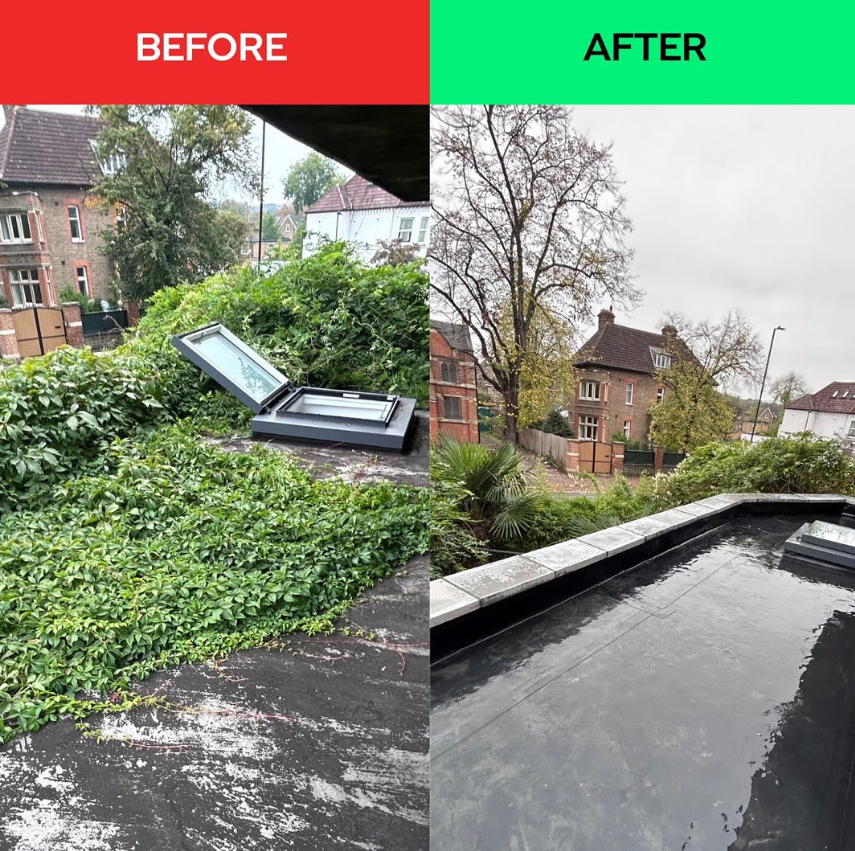
Flat Roofing Guide
What Material?
How long do they last?
This question is more often decided by two other factors. Firstly who and how well installed is the roof in the first place and has the roof been maintained properly. For example if the roof has been installed incorrectly fitted by a cowboy, a roof that is designed to last 30 years could only last months or weeks (we have been to jobs where a customer has had there roof installed by another contractor and its leaking the week after). Maintenance is also very important. If leaves or debris is left to build up in areas of a roof blocking drainage or piling higher than roof flashings then every roof will suffer a significantly shorter lifespan. Having said all this a well installed roof that is well maintained can perform to this level or better:
GRP / Fibreglass 20–30+ years
EPDM Rubber 20–30+ years
Liquid Systems 10–25 years
Torch-On Felt 10–15 years
Lead Sheet Roof 70-100+ years
Zinc Sheet Roof 80-100+ years
EPDM
EPDM has a relatively long lifespan, typically 20–30+ years when properly fitted. Provides a lower maintenance option and does not require regular coatings like liquid roofs or re-torching like felt. Its very resistant to moss, algae growth, and freeze–thaw cycles and is UV resistant so does not crack or degrade under sunlight (When installed correctly) so performs well in British rain, wind, and temperature swings. Another advanice is it come in large single piece membranes so many installations have no seams in flat basic shaped roof like subber house or extensions without skylights. In comparison to some of the other options it’s a very lightweight material per m2 suitable for modern timber joists without structural strengthening. EPDM is also fully recyclable and some mauratures make the sheets out of recycled car tyres which is a big reasons why we at Harris and Moore Bespoke use is as it coincides with our environment and sunabily commitments. A huge advantage over almost all other roofing materials is that EPDM can be patched repaired very easily, if a tree branch was to fall onto the roof and pierce the the membrane, a repair can often be make in a matter of minutes. In comparison to other materials that may take hours or days or in some cases require a whole new roof to repair.
Some of the disadvantages are the most common and lowest cost EPDM is a black rubber so absorbs heat (can increase summer surface temperature) it can look dusty and chalky over time. Another disadvantage is complex roofs with pipe penetrations, skylight upstands, and corners require skill and poor installation is the biggest cause of failures in the UK. EPDM is not good for Applications expecting heavy foot traffic such as balconies used as terraces.
Fibreglass GRP
GRP is a seamless waterproof surface that is applied in liquid form with fibreglass mat it cures into one continuous membrane meaning fewer leak risks and also has a long service life of typically 20–30+ years. It is also resistant to UV, temperature changes, and general weathering and has excellent impact resistance once cured. Unlike EPDM it can handle moderate foot traffic (e.g., for maintenance) and is great for complex Shapes like around upstands, skylights, corners and details. Some other bonuses are it comes in different colours and can even have a non-slip finish which is required for balconies & terraces.
Some of the disadvantages are that the installation is temperature sensitivity it needs dry weather and typically warmer temperatures to cure correctly if fitted on a very cold, damp day it can cause failures or weak bonding. Unlike EPDM, GRP can crack under movement as it is rigid once cured so if the roof deck moves, swells, or flexes, stress cracking can occur. It’s not ideal over large roofs without expansion breaks and expansion joints are needed over bigger surfaces without them as without them, the cracking risk increases.
Torch-On Felt
Felt is affordable and widely available so generally cheaper than EPDM and GRP (Not all the time) so can be attractive for garages, refurbishments, and on a tight budget projects. its a multi-layer system typically installed as 3 layers so reduces leak risk when done correctly. Its a tried & tested Technology and has been used in the UK for decades almost all roofers are familiar with it. It works on a range of surfaces like over timber decks, concrete, and insulation boards. It can also be easy to Repair.
Felt has a shorter lifespan typically 10–15 years. High-end systems may reach around 20 years in exceptional cases, but they rarely last beyond that without notable deterioration. Its a Heat-based installation and applied with a blowtorch, creating a genuine fire risk during installation. not ideal for timber or other combustible upstands unless specific precautions and fire-stopping measures are taken. It can’t be done in many places that have a ‘No Hot Works’ rule. Felt has multiple overlaps and joints that create more potential leak points compared with single-ply options such as EPDM or GRP, increasing the need for careful workmanship and inspection. The mineral-felt finish tends to look more “industrial” and utilitarian. Colour choices are limited (commonly grey, green or black), so options for matching architectural palettes are constrained. As it ages the membrane may require periodic patching, re-granulation or re-coating to address wear, granule loss and surface breakdown, adding to lifecycle maintenance needs.
Liquid Applied Systems
Applied as a liquid and cures into a continuous, fully bonded membrane so there is no joints or laps to fail (unlike traditional felt). Its a good product for repairs & overlays, it
can often be applied directly over existing felt, asphalt, or concrete surfaces, this minimises strip-out costs, time and site disruption. It’s great for complex details
pipes, upstands, rooflights and awkward corners as liquid systems can easily mould and seal around these features. Flexible & Crack-Resistant as many systems accommodate thermal and structural movement without cracking (unlike rigid GRP solutions). Modern formulations resist UV degradation and standing/ponding water. Many are cold-applied, removing the fire risk associated with torched systems. Like GRP it can handle foot traffic with an aggregate or non-slip finish, suitable for balconies, terraces and light pedestrian use.
The disadvantages are it is weather & temperature sensitive application method so must avoid like rain during curing, very cold/damp days poor curing = inconsistent thickness or failures. The thing to remember about this product is there is a big DIY markit for it and a big variety of quality across the cheaper products. The cheaper DIY liquids don’t perform as well as professional systems and are only really meant for temporary repairs. Not always suitable for full structural rebuilds. If insulation is being upgraded, system choice needs careful design.
Lead Sheet Roof
Lead is one of the oldest and most traditional materials used for roofing in the UK. It is still widely found on churches, heritage buildings, listed properties and period homes and most homes use some kind of lead flashing to this day in other parts of the roof. One of its greatest strengths is its longevity (when correctly installed) lead can last anywhere from 50 to over a 100, often outliving the building components around it. It also has “self-healing” characteristics due to the natural oxide layer that forms on the surface, which can help minor scratches and weathering marks seal themselves over time. Lead is a highly workable metal, allowing it to be formed around complex shapes, upstands, gutters, bay windows, dormers, parapets and other architectural details where many modern materials struggle. For this reason, conservation officers and heritage architects often specify lead, not only for durability but also for aesthetic authenticity and preservation of traditional appearance. It also requires relatively little maintenance over its service life, which adds to its appeal for long-term roofing solutions.
However, there are big disadvantages. Lead is very expensive both in terms of material cost and labour, on some of our projects the cost can be almost 10 times the cost of some other m. Installing it properly requires specialist skills, including correct bay sizing, welts, laps and expansion allowances, because lead moves significantly with temperature changes. If this thermal movement isn’t accounted for, fatigue fractures and splitting can occur over time. It is also a heavy material, meaning the underlying roof structure must be capable of supporting the load.
Zinc Sheet Roof
Zinc is a premium metal roofing material in the UK and is chosen for contemporary residential architecture as well as certain refurbishment projects. It offers a sleek, modern aesthetic with a distinctive patinated finish that can range from light grey to darker blue-grey tones depending on the treatment and age. One of zinc’s strongest appeals is its durability; a well-installed zinc roof can last 40 to 100 years or more, and it requires minimal maintenance during that time. Zinc is lightweight compared with lead or copper, which reduces the structural load on the roof deck and makes it suitable for both new builds and retrofits. Unlike membranes, zinc is typically installed using standing seams or flat lock joints, which give the surface its characteristic architectural lines. This is one of the reasons it is commonly seen on modern extensions, dormers and contemporary homes where the visual finish is part of the design intent.
However, Zinc roofing is not a cheap option, in our option it is the most expensive option that’s is reasonably common in the UK. Both the material and the installation require specialist contractors, and improper workmanship can lead to premature failure. Zinc also needs to be installed on suitable substrates with correct ventilation and separation layers; it does not perform well in persistently damp environments or when in direct contact with certain timbers or bituminous products that can cause corrosion. In cases where water frequently ponds on the surface. Zinc may suffer from accelerated wear because standing water interrupts the natural patina development. For that reason, zinc is often used on “flat” roofs that are actually designed with a higher pitch for drainage.
How to choose a good Roofer?
The best way we can answer this honestly is to explain ways that customers find us: Good Google reviews or online. Word of mouth from other trades or neighbours who have had work done or friends or family of our customers often recommend us. Other Trades know who’s good because they’ve seen the finishes in person.
There a number of different flat roofing materials used in the UK each with pros and cons and are best suited in different applications, some of the most common are:
EPDM (Ethylene Propylene Diene Monomer)A synthetic rubber membrane supplied in large sheets. GRP / Fibreglass (Glass Reinforced Plastic) A cold-applied resin-based system reinforced with fibreglass matting. Torch-On Felt (Bituminous Membrane) Multiple layers of bitumen felt applied with a blowtorch. Liquid Applied Systems (PU/Acrylic) Liquid resin that cures into a waterproof layer. Lead Sheet roof. Uses malleable lead sheets and bay rails. Zinc Roof. Uses zinc sheets for long-lasting, low-maintenance finish.
….And many more systems but theses are what we will go over in this guide.